Your AI System Will Break. Here’s How to Build One That Won’t.
Why the “GenAISys” Model-Agnostic Approach is the difference between adapting in minutes and rewriting code for weeks.
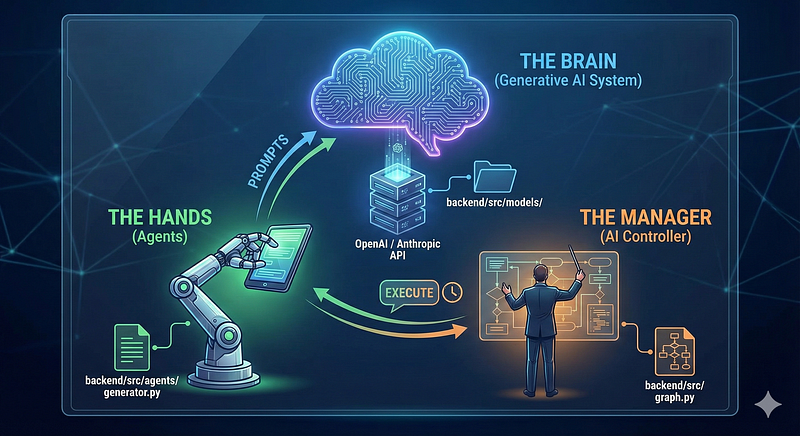
The Problem: The Fragility of Model-Centric Systems
In Part 1: The Trust Gap of my upcoming book GenAISys in Practice, I explore why AI systems fail (from hallucinations to mismatched user expectations). But one of the biggest threats to reliability isn’t the AI’s behavior; it’s the infrastructure itself.
Last year, as TIME reported, companies that built entire operations around specific platforms faced a brutal reality: their AI infrastructure wasn’t just changing, it was gone.
This highlights the fundamental fragility of Model-Centric Architecture, where your application logic is tightly coupled to a specific provider.
Here are the facts:
- Deprecation: Models like GPT-4 update or retire every 12–18 months.
- Cost Volatility: Prices fluctuate wildly.
- Compliance: New regulations (like the EU AI Act) may force you to switch to region-specific models like Mistral or Llama.
- New Models: Better-performing alternatives may (and probably will) emerge
If your code directly imports from openai import OpenAI inside your business logic, you aren't building a robust GenAISys. You are building a time bomb.
The GenAISys Architecture: Controller vs. Model
To build a sustainable system, we must apply the core philosophy of GenAISys Architecture: Strict separation of duties.
In a properly architected system, there are two distinct roles:
- The AI Controller (Chapter 4): This is the application logic. It holds state (memory), manages the workflow, executes tools, and decides what needs to be done. It is the deterministic “manager” of the process.
- The Model Component: This is the inference engine. It performs the non-deterministic task of reasoning and text generation.
The Golden Rule of GenAISys: The AI Controller governs the Workflow; the Model is just a swappable component that fulfills requests.
The mistake most teams make is hardcoding their Controller to speak only one language (e.g., the OpenAI API format). If that Model disappears, the Controller (and the entire Workflow) breaks.
The Solution: The Model-Agnostic Approach
This approach, detailed in Chapter 5, uses the Adapter Pattern to decouple the Workflow from the Model.
Let’s look at the code. We will compare a fragile implementation against the robust GenAISys approach.
1. Model-Centric
This is what many tutorials teach. It works for a hackathon, but it creates deep technical debt.
# FRAGILE: Workflow is coupled to the Model
# email_workflow.py
from openai import OpenAI

class EmailWorkflow:
    def __init__(self):
        # TIGHT COUPLING: The Workflow depends directly on OpenAI
        # PROBLEM 1: Tight coupling to OpenAI
        # PROBLEM 2: Hardcoded API key (high security risk)!
        self.client = OpenAI(api_key="sk-...")

    def run(self, product: str) -> str:
        # VENDOR LOCK-IN: Hardcoded model string and API structure
        response = self.client.chat.completions.create(
            model="gpt-4",
            messages=[{
                "role": "user",
                "content": f"Write a marketing email for {product}"
            }]
        )
        return response.choices[0].message.content
The Consequence: When you need to switch to Anthropic, you have to rewrite your Workflow logic, update imports, and debug new response parsers. This is weeks of work.
2. The GenAISys Way: Model-Agnostic
In GenAISys Architecture, we treat the Model as a generic component defined by an interface.
First, we define the Model Component Interface:
# ROBUST: The Contract
# components/models/base.py
from abc import ABC, abstractmethod

class BaseModel(ABC):
    """The GenAISys Contract: Every model must obey these rules."""

    @abstractmethod
    def generate(self, prompt: str) -> str:
        """Takes a prompt, returns a string. No API complexities exposed."""
        pass
Next, we build a Model Adapter for OpenAI. If the API changes, we only fix this one file.
# components/models/openai_adapter.py
from components.models.base import BaseModel
from openai import OpenAI

class OpenAIModel(BaseModel):
    def __init__(self, model_name: str = "gpt-4"):
        self.client = OpenAI() # The Correct Way uses OPENAI_API_KEY env var
        self.model_name = model_name

    def generate(self, prompt: str) -> str:
        response = self.client.chat.completions.create(
            model=self.model_name,
            messages=[{"role": "user", "content": prompt}]
        )
        return response.choices[0].message.content
Finally, the AI Controller (The Workflow). Notice it doesn’t import openai. It interacts only with the abstract BaseModel.
# workflows/email_workflow.py
from components.models.base import BaseModel

class EmailController:
    def __init__(self, model: BaseModel):
        # DEPENDENCY INJECTION: The Controller works with ANY valid model
        self.model = model

    def execute_workflow(self, product: str) -> str:
        # The Controller focuses on logic, delegating inference to the component
        return self.model.generate(prompt=f"Write a marketing email for {product}")
Why This Matters for “The Trust Gap”
You might ask: “Why build this abstraction?”
In Chapter 1, we discussed the “Trust Gap” — the difficulty in trusting AI to be reliable. Model agnosticism closes this gap by enabling A/B Testing and Fallback Mechanisms.
With this architecture, switching models or running experiments becomes a configuration change, not a code rewrite:
# A/B Testing becomes trivial in GenAISys
gpt4_component = OpenAIModel(model_name="gpt-4")
claude_component = AnthropicModel(model_name="claude-3-opus")

# Run the exact same workflow through different brains
result_a = EmailController(gpt4_component).execute_workflow("Running Shoes")
result_b = EmailController(claude_component).execute_workflow("Running Shoes")
Summary
In a robust GenAISys, the Model is a utility — like electricity or a database — not the foundation.
By decoupling your AI Controller (Workflow) from the Model Component, you gain:
- Resilience: API deprecations become minor config updates.
- Flexibility: You can swap models based on cost or performance needs.
- Control: You ensure your Workflow Logic dictates the process, not the quirks of a specific model.
Now that we have a stable architecture, we face the next challenge in Workflow Design. A generic model is smart, but it doesn’t know your business data.
In the next part of this series, we will look at GenAISys Components vs. Agents and how to give your system memory using Retrieval-Augmented Generation (RAG).
Dan Collins is an Agentic AI Engineer who finds as much joy in explaining complex systems as he does in building them. A builder at heart with a teacher’s mindset, he is currently developing the GenAISys framework to help fellow engineers turn fragile AI prototypes into robust, production-grade architectures.